Types of intraocular lenses
Diffractive and refractive intraocular lenses
New treatment options for presbyopia (the age-related loss of elasticity of the lens, resulting in an inability to focus at different distances) are increasingly at the forefront of modern ophthalmology. For many patients, correction with glasses is unacceptable, and they are looking for a way to become independent of glasses. The latest treatment approaches include artificial multifocal intraocular lenses, which have two or more optical powers and therefore allow vision both at distance and near. They are used in the treatment of cataract, but also as a refractive procedure in patients with presbyopia (inability to focus on near objects). Artificial intraocular lenses replace the eye's own natural lens. More than 60 years have passed since the first implantation of an artificial intraocular lens, and their development has advanced considerably.
Today, a wide range of artificial multifocal intraocular lenses is available, based on the principle of combining several optical powers in a single lens. Modern trifocal intraocular lenses provide vision at near, intermediate and far distances. They eliminate or reduce the need for glasses or contact lenses, but at the same time they may cause symptoms such as halos around light sources at night, glare in certain low-light conditions and reduced contrast sensitivity. Most patients get used to these phenomena over time and do not find them very disturbing. Patients with glaucoma, diabetic retinopathy, diabetic macular oedema or macular degeneration are not suitable candidates for replacement of the lens with an artificial multifocal lens.
Before surgery, our doctors precisely calculate the artificial intraocular lens to suit each patient's individual needs.
- trifocal (diffractive) – for near, intermediate (e.g. computer) and distance vision
- multifocal (refractive) – for distance and near vision
- combined
Trifocal diffractive intraocular lenses
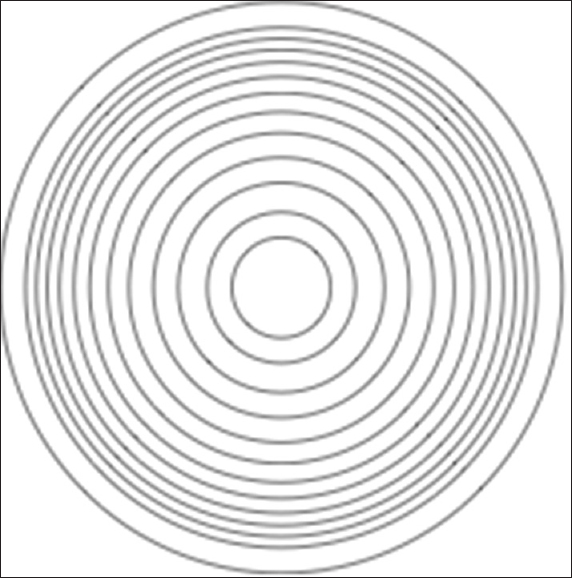
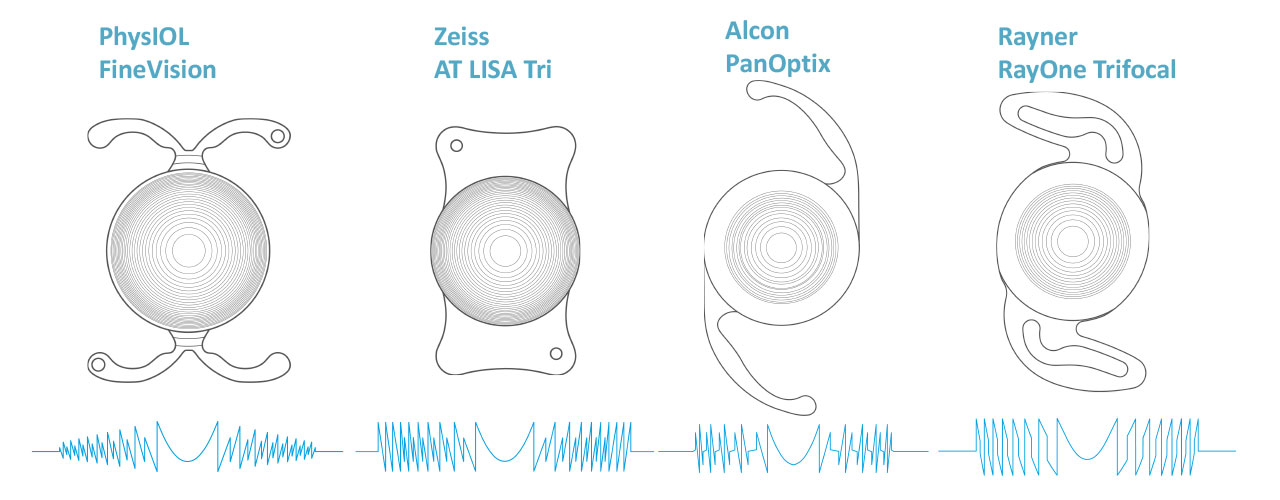
help to provide sharp vision at three distances – near, intermediate and far – with a dominant centre surrounded by a system of 12–16 concentric rings of constant optical power. These rings bend the light passing through the lens for near and far vision, regardless of pupil size. Although diffractive intraocular lenses are not limited by pupil size, their disadvantage is weaker visual acuity at intermediate distance.
Trifocal diffractive lenses:
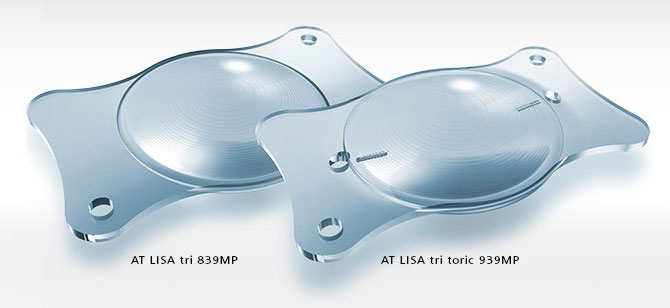
1. AT LISA tri 839MP by ZEISS
- high visual acuity at all distances and in all lighting conditions
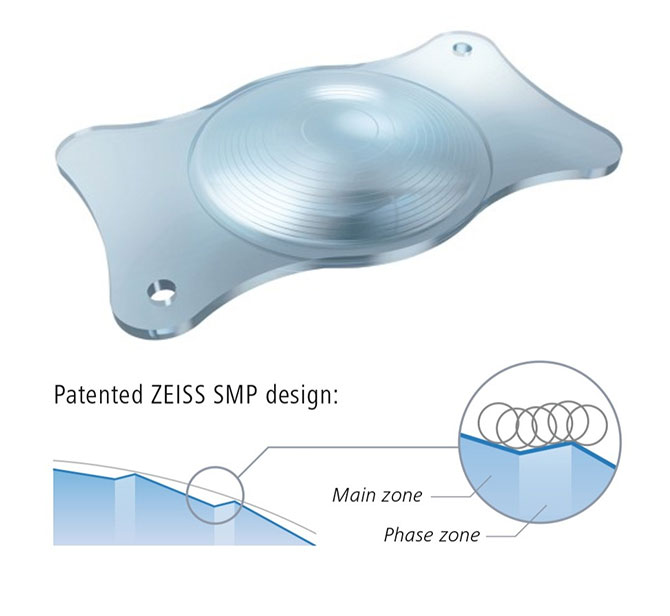
2. AT LISA tri 829MP by ZEISS
- these multifocal implants are hydrophobic and help the eye to focus at all distances depending on how much light there is in the environment, thus optimising the quality of vision in all lighting conditions
- they are designed for patients who want to resolve both presbyopia and cataract in a single operation

3. Alcon AcrySof IQ PanOptix
- a new generation of EDoF (Extended Depth of Focus) lenses with sharp vision at all distances and in all lighting conditions
- excellent optical properties for active people with a wide range of interests, even in low-light conditions

4. VSY Biotechnology AcrivaUD Trinova
- new-generation trifocal intraocular lenses based on the so-called SVT (Seamless Vision Technology), which provides smooth, continuous sharp vision at all distances.
- the patented technology does not use the sharp, angular/stepped edges of diffractive zones used until now; instead, the individual zones have a wavy, sinusoidal surface (reminiscent of concentric ripples on water after a stone has been dropped in). The optical powers therefore act homogeneously and, in addition to sharp vision at all distances, halo effects are largely eliminated.
- AcrivaUD Trinova ensures maximum light transmission thanks to its rounded diffractive zones and offers higher contrast sensitivity and dynamic visual acuity at all distances

5. RayOne® Trifocal lens
- proven rotational stability in the capsular bag after surgery thanks to the haptic technology
- smooth transition from near to intermediate and far vision thanks to 16 diffractive rings
- low dependence on lens size and lighting conditions
Optimised patented diffractive design
RayOne® Trifocal has a new diffractive profile designed in collaboration with a leading European technology institute. Over the past four years, Rayner has developed the most advanced optics in the company's history, and probably the most advanced in the entire industry.
A diffractive profile composed of two profiles, forming our patented design:
| RayOne® Trifocal |
 |
Comparison of trifocal technologies
Multifocal refractive intraocular lenses

help to provide sharp vision at distance and near. They originally consisted of 5 concentric rings of the same optical power. However, the development of the second generation of these lenses brought a merging, i.e. a widening of the second and third zones and a reduction of the fourth and fifth zones. This reduced visual disturbances and irregularities. Refractive intraocular lenses provide good visual acuity at all distances (far and near), but they are limited by variations in pupil size.
Conclusion: Today, in addition to treating cataract, artificial intraocular lenses can be used to correct short-sightedness, long-sightedness, astigmatism and presbyopia. Which type of intraocular lens is suitable for which patient depends on the patient's age, the type of refractive error and any other eye diseases. The patient's hobbies, occupation and expectations are also important when choosing an intraocular lens.